
Countries · Spain
Mobile coverage in Spain: the ministry's register and four networks
Spain's antenna data comes from a government viewer, not from the operators. Here is what it lists, how the four networks share spectrum and sites, and what the official 5G coverage figures measure.
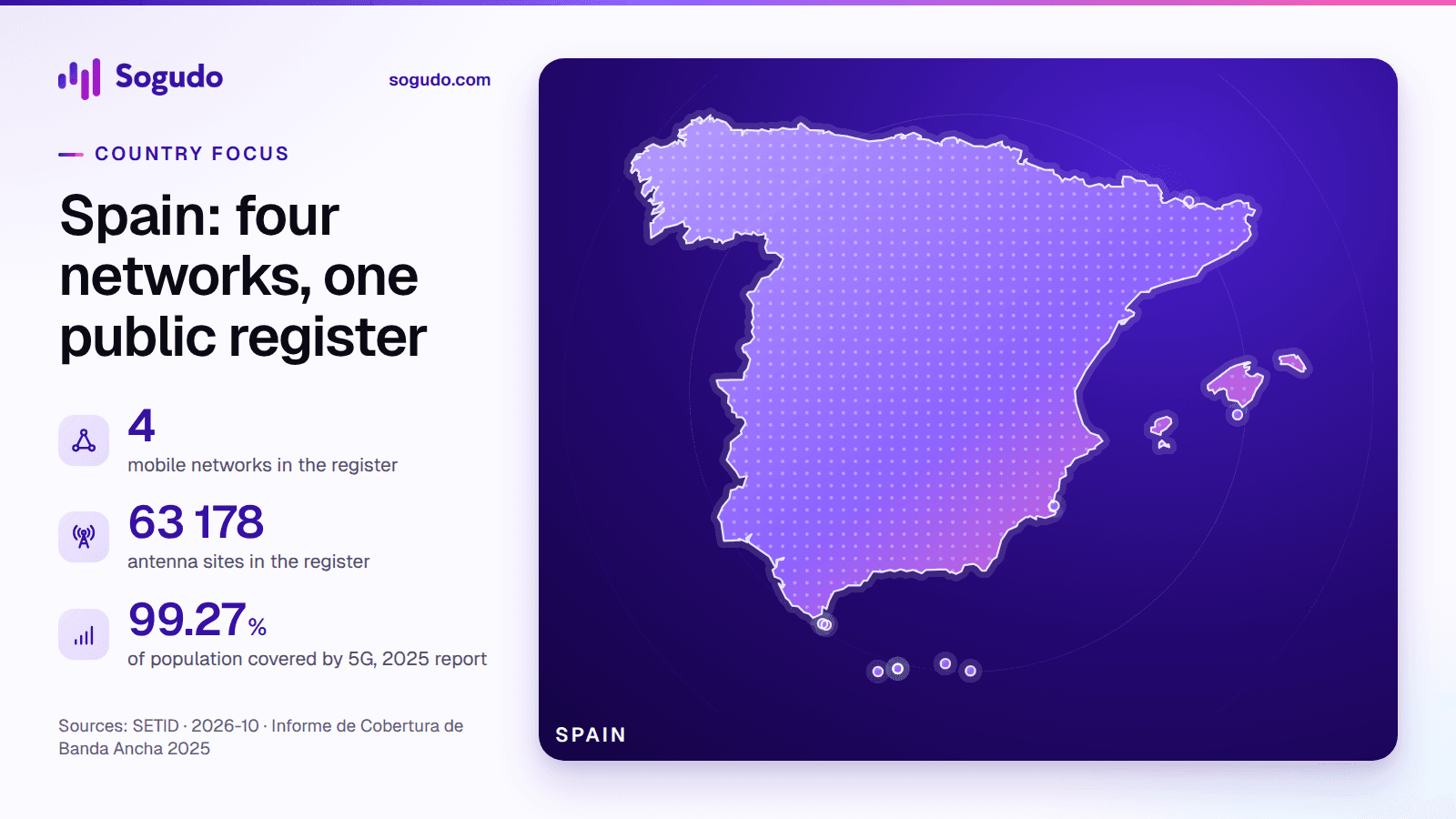
Zoom far enough into the Spanish government's antenna viewer and mobile base stations appear as icons on the map, with a warning that their positions are only indicative [1]. The viewer is run by the Secretariat of State for Telecommunications and Digital Infrastructure (SETID), part of the Ministry for Digital Transformation and Civil Service, and it is the public source of Spain's antenna data. In the October 2026 edition of the register used for Sogudo's map, it lists 63,178 antenna sites belonging to four mobile networks.
Where the antenna data comes from
For each site the register gives a location, the operator, the technologies and the frequencies in use. It publishes no antenna heights and no azimuths, the compass bearings in which sector antennas point [1]. A reader can therefore see where a network has built, but not how high its antennas sit or which way they face, two things that strongly affect how far a signal travels.
Two public bodies share the role that a single regulator plays in some countries. The ministry runs the register and publishes the annual broadband coverage report [2]. The National Commission on Markets and Competition (CNMC) publishes market statistics: Spain had 63.24 million mobile lines in June 2026, and Movistar, Vodafone and MasOrange held 85.5% of them, or 98.1% with DIGI included [3].
Four networks, one of them still young
| Network | Antenna sites | 3G | 4G | 5G |
|---|---|---|---|---|
| Movistar | 22,889 | 9,644 | 22,562 | 22,399 |
| Vodafone | 19,776 | none | 19,759 | 19,254 |
| MasOrange | 18,559 | 9,992 | 18,451 | 18,395 |
| DIGI | 1,954 | none | 1,954 | 1,954 |
The frequencies tell more than the totals. Movistar's 5G sites most often list 3,460 MHz (10,348 sites), and MasOrange's most often list 3,600 MHz (5,925 sites). Vodafone's 5G sites most often list 1,825.1 MHz (7,010 sites) and 949.9 MHz (6,093 sites). A lower frequency carries farther from the same mast, so a 5G site in the 900 MHz range and one in the 3.5 GHz range do not cover the same area. Our article on why distance alone does not predict coverage explains why.
DIGI is the newcomer with its own radio network. In the same edition of the register its 1,954 sites all carry 4G and 5G. The company itself reported 1,363 active nodes in June 2026, with deployment begun in July 2025, and plans up to 10,000 base stations by 2033 [5]. The two figures come from different dates and different ways of counting, so they need not match. DIGI had 7.83 million mobile customers at the end of June 2026 [6].
Sharing, roaming and rural 5G
Most DIGI customers are still served largely by Telefónica's network. In July 2024 the two companies signed a 16-year agreement for national roaming and RAN sharing (sharing the radio access network, meaning the antennas and base stations), in force from 1 January 2025 [4]. Because of that agreement, DIGI's coverage reaches far beyond its own sites in the register.
Vodafone and Orange signed a network-sharing agreement before the market took its present shape. In 2019 they extended active RAN sharing to municipalities of up to 175,000 inhabitants, covering 2G, 3G and 4G on 14,800 sites, while each kept its own network in the large cities [7]. Orange then combined its Spanish business with MásMóvil in a joint venture, MasOrange, that began operating on 26 March 2024 [8], and Vodafone completed the sale of Vodafone Spain to Zegona on 31 May 2024 [9].
Whether the 2019 arrangement still applies in the same form has not been publicly confirmed. In July 2026 Vodafone and MasOrange were reported to have resumed preliminary contacts on a joint company for their mobile radio networks, although a MasOrange spokesperson said there was no open project [10].
In the countryside, the three largest networks also pool spectrum. Under the state-funded UNICO 5G Redes Activas programme, which offers €544 million for municipalities of under 10,000 inhabitants without 4G at 50 Mbps or more [12], Telefónica, Vodafone and MasOrange agreed to share their combined 30 MHz in the 700 MHz band. The operator that builds in a subsidised area can use all three companies' spectrum to guarantee the 100 Mbps the government requires [11].
2G and 3G: one switch-off done, more to come
- Vodafone: 3G shut down, with Madrid and Barcelona the last cities, scheduled for the end of October 2024 [13]. It has no 3G in the October 2026 edition of the register.
- Movistar: 3G switch-off under way and due to be completed by the end of 2027; 2G is also scheduled to go in 2027 and is kept running in the meantime for older phones and basic telemetry devices [14].
- MasOrange: 3G off by 31 December 2027 and 2G by 31 December 2030 [15].
- DIGI: its own sites in the register carry only 4G and 5G [1].
The government launched a public consultation on the switch-offs in December 2025, open until 20 January 2026. No 2G date had been set for all operators at the time, partly because devices such as vehicle eCall emergency systems still use 2G [16].
What the official coverage figures measure
The ministry's Informe de Cobertura de Banda Ancha 2025, presented on 6 May 2026, puts 5G coverage at 99.27% of the population and 96.13% in rural areas. Standalone 5G, which runs on its own 5G core network rather than on a 4G one, reached 98.1% of the population, 54 points more than in 2024; in rural areas it rose from 12.39% in 2024 to 91.22% [2]. These are shares of population, not of territory: a network can cover nearly every inhabitant and still leave empty mountains and plateaus without signal. Interactive maps from national down to municipal level accompany the report [2].
Resilience is the next question. On 25 June 2026 the government announced that operators must keep mobile coverage running for four hours during a power cut for 75% of the population, phased in at 50%, 65% and then 75% over three years under a decree expected before the end of 2026 [17]. In March 2026, in its report on the draft royal decree on the security and resilience of electronic communications networks, the CNMC had suggested introducing the energy autonomy requirements for mobile networks gradually and, in some areas, preferring cheaper solutions such as roaming between networks [18].
Counts per operator, technology and band, with the data month, are on the Spain page.
References
- Niveles de Exposición (visor de localización de estaciones de telefonía móvil)
- El 5G alcanza ya al 99% de la población española y al 96% en zonas rurales, en una reducción histórica de la brecha digital
- La portabilidad móvil creció casi un 8 % interanual en junio
- Telefónica and DIGI sign new mobile network agreement for the next 16 years
- DIGI reported Adjusted EBITDA ex-Operating Leases of 104 million up to June, up 48% year-on-year
- DIGI Spain H1 2026 slides: margins widen as network expansion accelerates
- Orange y Vodafone amplían sus acuerdos de compartición de redes móviles y fijas en España
- Orange and MASMOVIL complete transaction to form the leading operator in Spain in terms of customers
- Sale of Vodafone Spain completes
- Vodafone y MasOrange retoman los acercamientos para integrar sus redes móviles en una nueva gran empresa conjunta
- Telefónica, Vodafone and Masorange to share 700MHz for rural 5G
- Conoce el programa UNICO Redes Activas para llevar el 5G a la España rural
- Vodafone Spain to complete 3G shutdown next month
- Movistar apaga el 3G pero mantiene el 2G activo: la paradoja de la red más vieja como tabla de salvación
- Masorange apagará su red de 3G en 2027 y la de 2G en 2030 para reforzar sus servicios 5G ante el aumento del tráfico
- Movistar, MasOrange y Vodafone apagarán las redes 2G y 3G: el Gobierno pone en marcha el plan
- Óscar López anuncia que el Gobierno obligará a mantener la cobertura móvil 4 horas en caso de apagón
- La CNMC propone mejoras en la normativa para garantizar la seguridad de las telecomunicaciones en situaciones de emergencia
- 3GPP TR 38.901, Study on channel model for frequencies from 0.5 to 100 GHz